- What Exactly Does Companion Planting Involve?
- Golden Combination #1: Tomatoes + Basil + Marigolds
- Golden Combination #2: Legumes + Dwarf Corn (or Sunflowers) + Creeping Vines
- Golden Combination #3: Lettuce + Green Onions (or Scallions)
- Golden Combination 4: Cucumber + Dill + Golden Pansy
- Golden Combination #5: Carrots + Chives (or Green Onions)
- Herb Combinations: The Mediterranean Herb Trio
- Flower Sentinels: Marigolds and Golden Pansies
- "Bad Neighbors" to Avoid
- Three Practical Solutions for Companion Planting in Containers
- Four Core Principles of Companion Planting
When growing vegetables in limited space, planting individual plants in isolation is often not the best solution. By arranging compatible plants together, they can repel pests, share nutrients, provide shade, and retain moisture—turning the entire planter into a small, self-sustaining ecosystem. This approach, known as “companion planting” or “Small-Space Companion Planting” in European and American balcony gardening, isn’t a mystical practice; it’s achieved through scent interference, root-system interactions, and complementary use of space.
The following guide is specifically designed for container gardening. It can be applied directly to a balcony vegetable garden, patio garden, and rooftop vegetable garden.
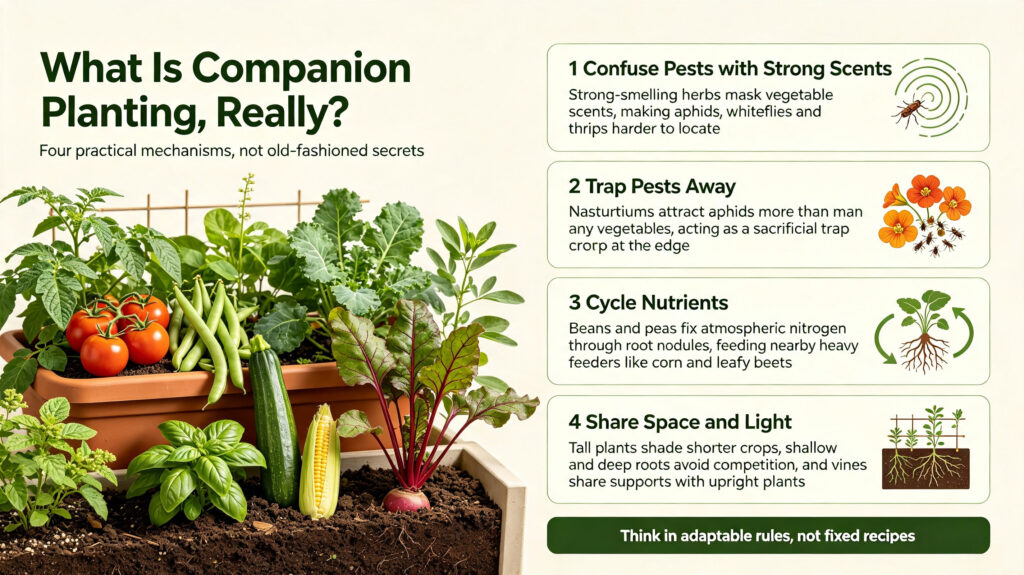
What Exactly Does Companion Planting Involve?
Many people think that companion planting is simply “cramming two types of vegetables into one pot,” but in fact, it’s based on four key principles.
Odor distracts pests. Many pests rely on scent to locate their hosts. Planting strongly scented herbs next to vegetables is like covering the main crop with a layer of “scent camouflage,” making it difficult for aphids, whiteflies, and thrips to pinpoint their target.
Attract-and-trap method. Some plants are particularly attractive to pests, which paradoxically protects the main crop. A classic example is the golden peltier—aphids prefer it over almost any other plant. Planting it along the edge of the pot causes aphids to congregate on the golden peltier instead.
Nutrient Cycling. Legumes (such as beans and peas) form a symbiotic relationship with rhizobia in their root systems, fixing atmospheric nitrogen into the soil. Nearby heavy-feeding crops (such as corn and leaf beet) can benefit directly from this.
Complementary use of space and light. Tall plants shield shorter ones from the midday sun, shallow-rooted and deep-rooted plants are paired so they don’t compete for nutrients, and vines and upright plants share the same trellis.
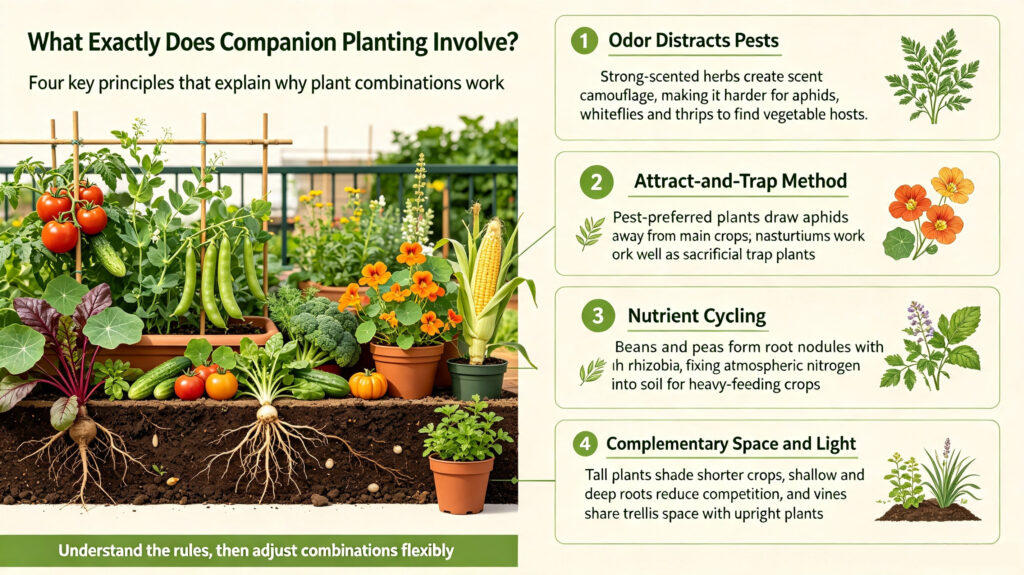
Once you understand these four principles, all the combinations discussed below are no longer “ancestral secrets,” but rather rules you can flexibly adjust on your own.
Golden Combination #1: Tomatoes + Basil + Marigolds
This is the most thoroughly tested combination in container companion planting—there’s virtually no “one of the best” here.
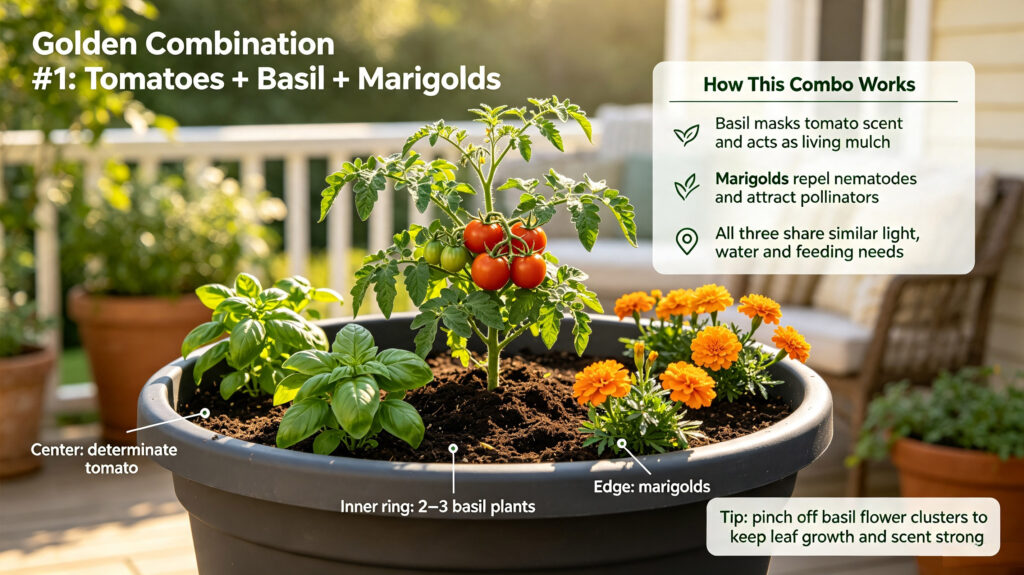
The aromatic oils emitted by basil disrupt aphids’, whiteflies’, and thrips’ ability to locate tomato plants. At the same time, basil fills the space at the base of the tomato plants, acting as a living mulch that reduces moisture evaporation from the soil surface.
Marigolds, on the other hand, are “all-around bodyguards”—their root systems release compounds that repel soil nematodes, their flowers attract pollinators such as bees, and they disorient whiteflies and thrips in flight.
Planting arrangement recommendation: Use a deep pot holding at least 5 gallons (about 19 liters). Plant a determinate tomato in the center, surround it with 2–3 basil plants, and place the marigolds on the outer edge of the pot—either in the same pot or in adjacent small pots. Since all three plants have identical light, watering, and fertilization schedules, they are effortless to care for.
Tip: Once basil bolts and begins to flower, its production of essential oils decreases, and its insect-repelling effect weakens accordingly. Pinch off flower clusters as soon as you see them so the plant can continue to direct its energy toward leaf growth.
Golden Combination #2: Legumes + Dwarf Corn (or Sunflowers) + Creeping Vines
This is a container-based adaptation of the “Three Sisters” planting method, which originated with Native Americans.
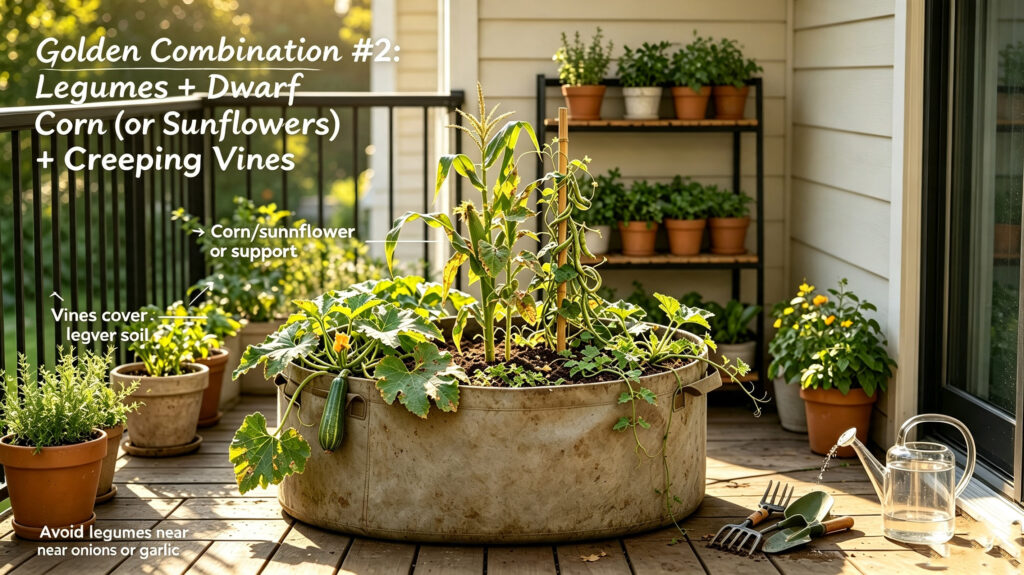
Legumes fix nitrogen and act as natural nitrogen factories; dwarf corn or sunflowers serve as climbing supports for the legumes; the vines (such as winter squash or cucumbers) spread their leaves across the soil surface to retain moisture and suppress weeds.
For the balcony version, use a large container or planting bag of at least 30 liters: plant the corn (choose a dwarf variety) in the center, surround its roots with legumes, and let the vines crawl outward along the rim of the pot.
If space does not allow for vines, at least pair legumes with dwarf corn—the nitrogen fixed by the legumes directly nourishes the corn, while the corn stalks serve as a natural trellis for the legumes, with both plants supporting each other.
It is important to note that legumes and alliums (such as onions and garlic) are “arch-enemies”; never plant them together in the same pot or in adjacent pots (see the “Taboos” section below for details).
Golden Combination #3: Lettuce + Green Onions (or Scallions)
This combination is ideal for shallow containers and windowsill gardening.
Lettuce has a shallow, spreading root system, while green onions have a vertical root system that takes up little space. The two can share a container without competing for root space.
The pungent scent of scallions repels aphids and beetles that attack lettuce, and the upright scallion leaves improve air circulation in the pot, reducing the risk of fungal diseases. In turn, the lettuce’s broad leaves provide shade and retain moisture for the shallow-rooted scallions.
A shallow pot 10 inches (about 25 centimeters) wide can accommodate 4–5 heads of lettuce, paired with a few clumps of scallions. By sowing lettuce in batches every two weeks, you can enjoy a continuous harvest.
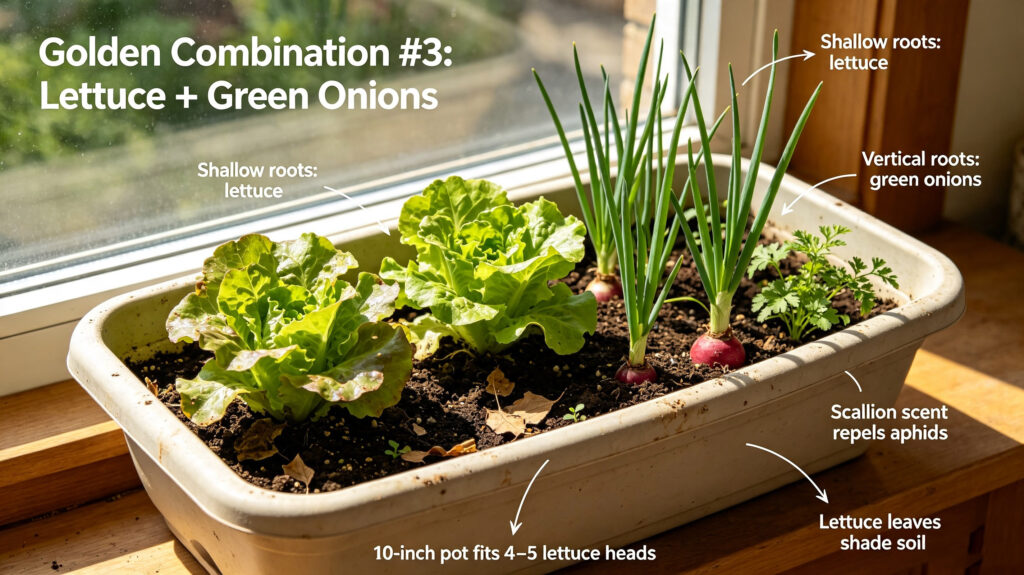
A similar combination could be: lettuce + radishes + cilantro + green onions. Each of these four plants takes its place in the shallow pot, and when harvested, they make up a complete salad.
Golden Combination 4: Cucumber + Dill + Golden Pansy
Cucumbers are high-yielding stars on the balcony, but they also attract many pests—cucumber beetles, aphids, and mites are all common visitors.
Dill attracts beneficial insects such as ladybugs, lacewings, and parasitic wasps, which are natural predators of aphids and cucumber beetles. At the same time, the compounds released by dill have a direct repellent effect on certain pests.
As a trap crop, the golden lotus “lures” aphids onto itself, protecting the cucumbers from damage. Once aphids have gathered on the golden lotus to a certain extent, pull up the entire plant and discard it—the cucumbers will remain unscathed.
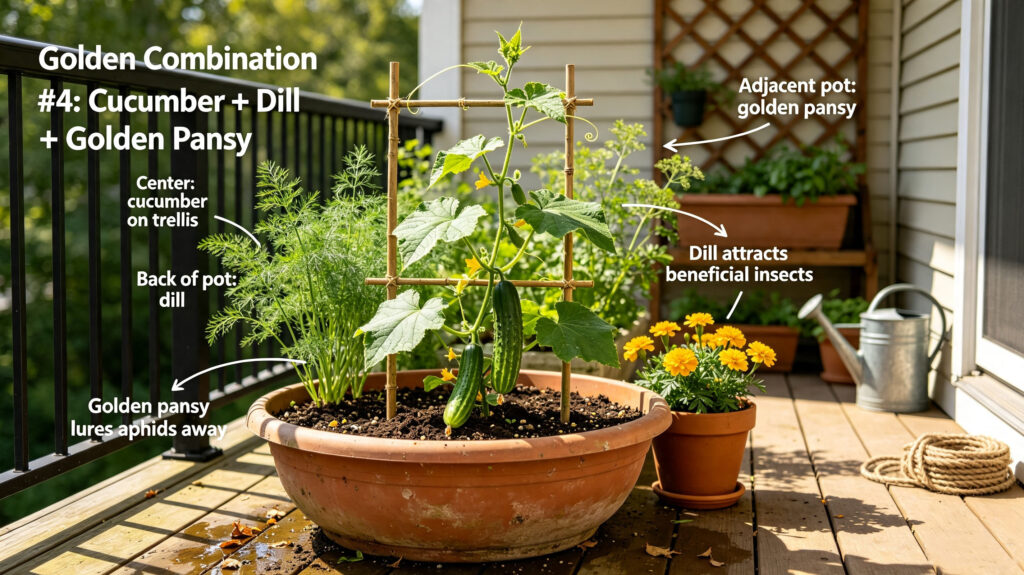
Planting Tips: Plant the cucumber in the center of a large pot and set up a trellis. Plant the dill at the back of the pot (making sure not to block the cucumber vines), and plant the tagetes separately in an adjacent small pot—since tagetes roots compete fiercely for water, planting them in the same pot would actually hinder the cucumber’s growth.
Golden Combination #5: Carrots + Chives (or Green Onions)
This pair is a classic root vegetable combination in European and American vegetable gardens.
The volatile scent of chives masks the scent trail of carrots, making it difficult for “carrot flies” to locate their target. Meanwhile, the carrots’ fine, feathery leaves do not block the chives from receiving sunlight.
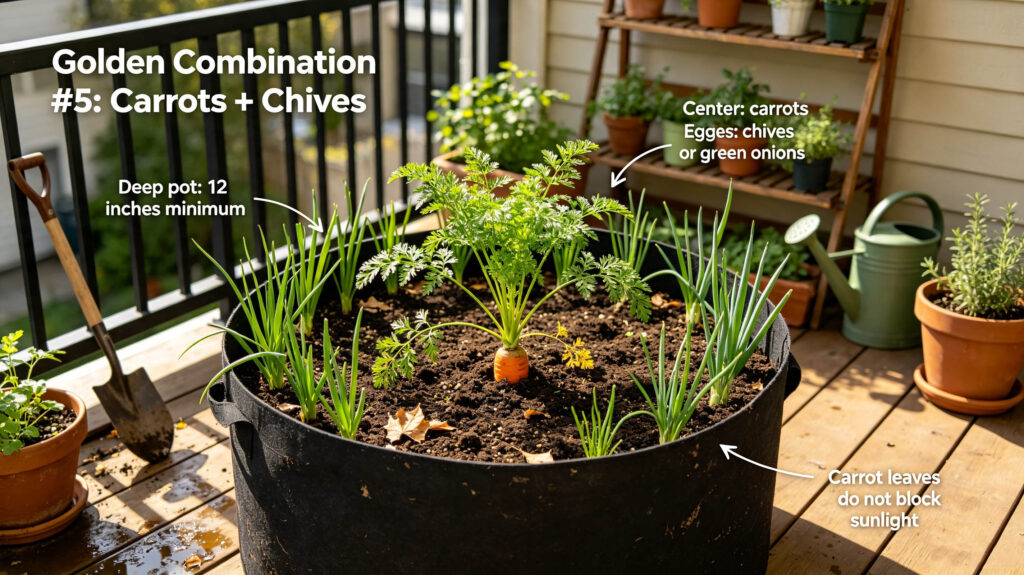
Container Selection: Choose a deep pot at least 12 inches (about 30 centimeters) deep to ensure the carrots have room to grow downward. Scatter the carrot seeds in the center of the pot and plant the scallions along the edges.
Herb Combinations: The Mediterranean Herb Trio
If you want to create a pure herb planter, the most reliable combination is rosemary, thyme, and oregano.
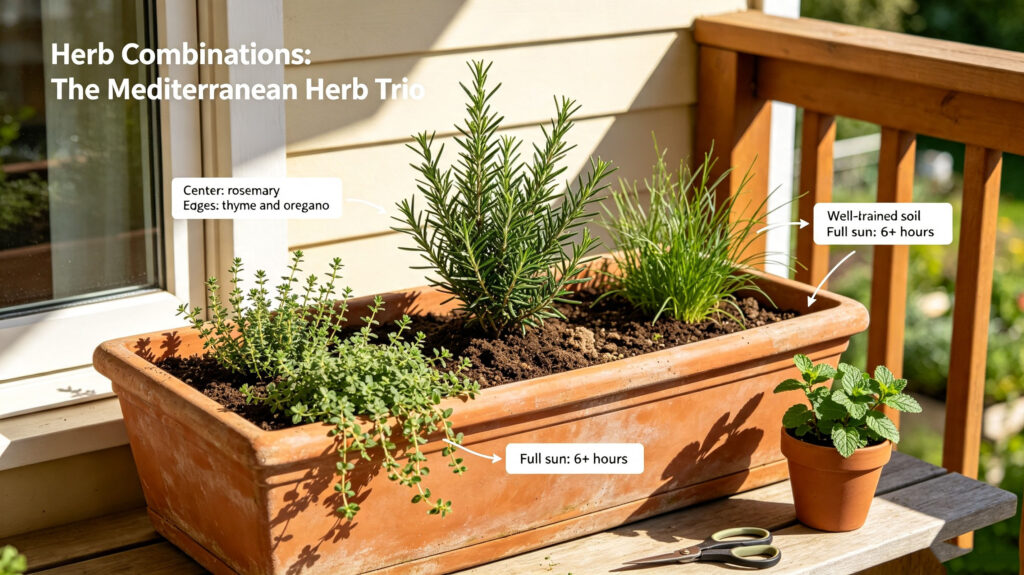
These three Mediterranean herbs share the same growing preferences: full sun (at least 6 hours a day), extremely well-drained soil, and drought tolerance with minimal watering. Rosemary serves as the central anchor, thyme cascades over the edge of the pot, and oregano grows upright along the sides.
Not only do they complement each other, but they also provide a natural pest-repelling barrier for the entire balcony—any vegetable pot placed next to a pot with this combination will benefit.
Mint is an exception. Mint has extremely aggressive roots, and planting it in the same pot will cause it to take over the entire container within weeks. The correct approach is to plant the mint in its own small pot and place it next to the vegetable pot, allowing the scent to work its magic while keeping the roots from interfering with each other.
Flower Sentinels: Marigolds and Golden Pansies
If your balcony has only a small corner for growing vegetables, be sure to place at least one pot of marigolds there.
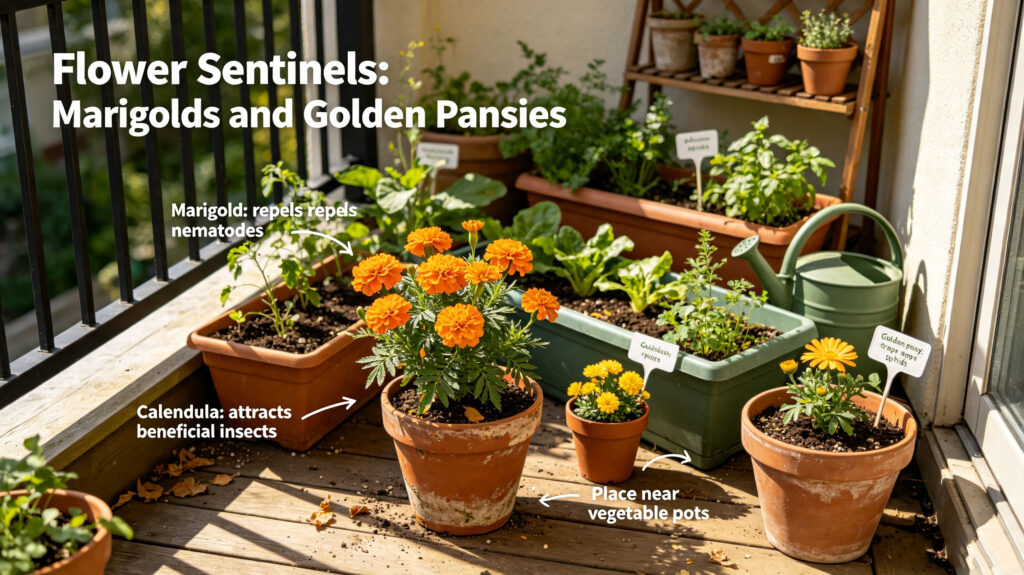
Marigolds are known as “all-purpose companion plants”—their root exudates kill soil nematodes, the scent of their flowers confuses whiteflies and thrips, and their bright yellow blooms attract pollinators like bees. Placing a pot of marigolds next to almost any vegetable pot can reduce pest pressure.
The golden peltier is a “pest-attracting expert.” It is extremely attractive to aphids, making it an excellent trapping crop. Planting it at the edge of a pot or in an adjacent pot is like setting up a “pest collector” for your balcony garden.
Calendula is another sentinel worth having. Its flowers attract aphid-eating flies (whose larvae feed on aphids) and parasitic wasps, providing biological control for insect-pollinated crops such as cucumbers and peas.
“Bad Neighbors” to Avoid
Just as companion planting has “good partners,” it also has “bad roommates.” The following combinations should be especially avoided in balcony containers:
Onions and garlic ❌ Legumes. Onions, garlic, and Chinese chives secrete substances that inhibit the rhizobia in legumes, reducing the legumes’ ability to fix nitrogen and causing both plants to grow poorly. Since balcony space is limited, plant them in separate pots and keep them at least 1 meter apart.
Fennel ❌ Almost all vegetables. Fennel roots secrete substances that inhibit the growth of neighboring plants, making it a “lone wolf” in companion planting. Give it its own pot and do not mix it with any other vegetables.
Tomatoes ❌ Potatoes. Both belong to the Solanaceae family and are prone to spreading late blight to each other. Although balcony container gardening does not involve direct contact with soil, placing them too close together increases the risk of disease transmission; it’s best to keep them separated.
Tomatoes ❌ Cruciferous vegetables (cabbage, broccoli, etc.). Both are heavy feeders and will compete fiercely for nutrients in the limited potting soil.
Mint ❌ Any other plant in the same pot. As mentioned above, mint must be grown in its own pot.
Three Practical Solutions for Companion Planting in Containers
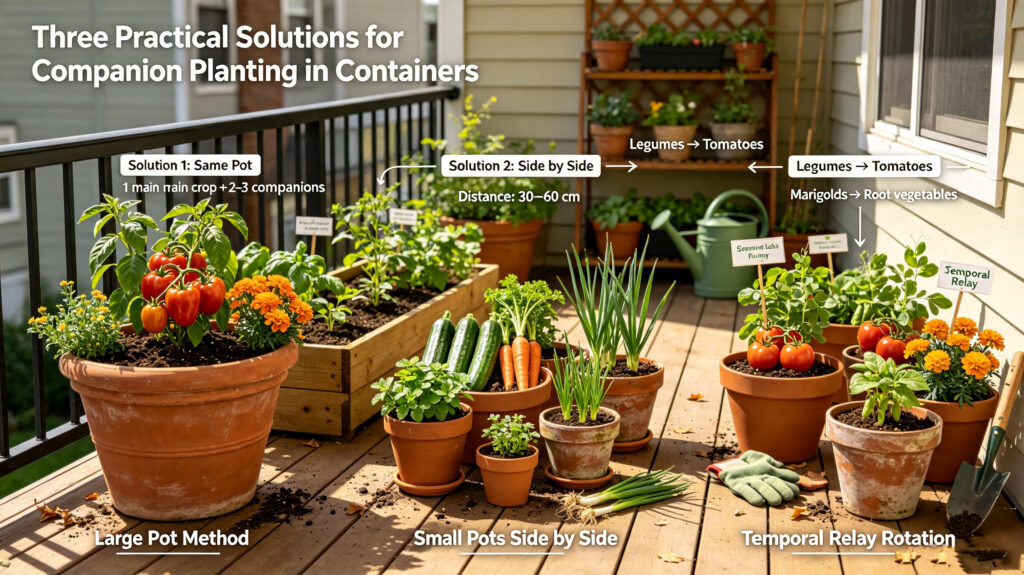
Now that you know which plants are good companions and which are incompatible, the key is how to implement this on your balcony. Here are three solutions you can put into practice right away:
Solution 1: Interplanting in the Same Pot (Large Pot Method)
Use a large pot with a diameter of 30 centimeters or more. Plant the main crop in the center and the companion plants around the edges. Typical examples include: tomatoes + basil + marigolds, chili peppers + basil + calendula, and lettuce + scallions.
The key is not to overcrowd the pot—a 10-gallon (approx. 38-liter) pot can accommodate at most “1 main crop + 2–3 companion plants”; overcrowding will inevitably harm both.
Option 2: Placing Side by Side (Small Pots)
When there isn’t enough space to plant them in the same pot, place small pots side by side. For example: a pot of mint next to a pot of cucumbers, a pot of scallions next to a pot of carrots, or a pot of marigolds next to any vegetable pot.
The effective distance for preventing odor interference is about 30–60 centimeters, so don’t place the pots too far apart.
Option 3: Temporal Relay (Rotational Companion Planting)
Plant legumes (nitrogen-fixing) this season, followed by tomatoes (fertility-loving) next season to utilize the nitrogen left behind by the legumes; plant marigolds (which kill nematodes) this season, followed by root vegetables (which are susceptible to nematode damage) next season. This applies the principle of companion planting to the temporal dimension.
Four Core Principles of Companion Planting
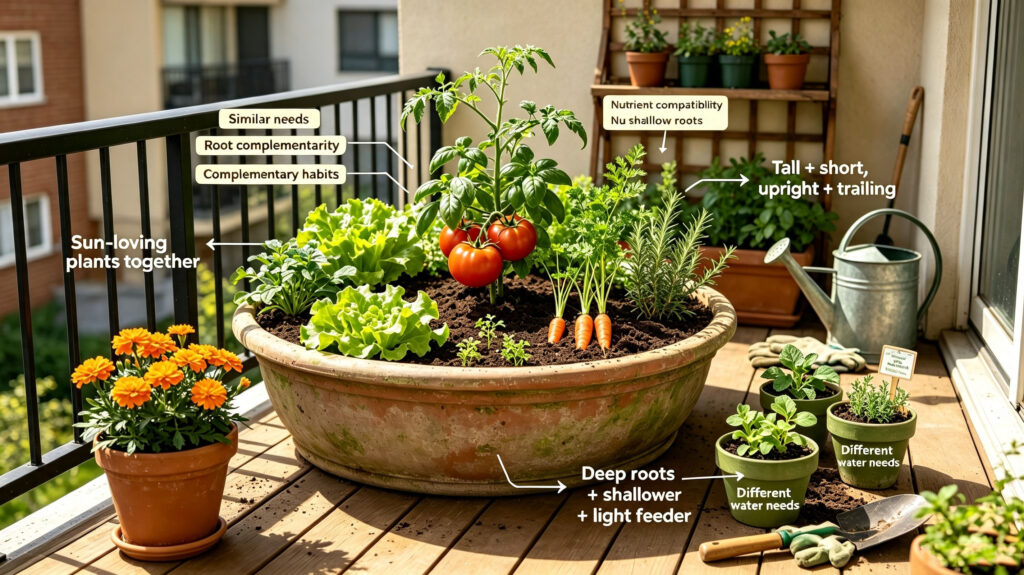
No matter how you combine plants, the following four principles will help you determine whether any two plants are suitable for growing together:
Similar needs. The plants you pair should have similar requirements for light, water, and temperature. Don’t plant sun-loving tomatoes and shade-tolerant mint in the same pot; nor should you plant drought-tolerant Mediterranean herbs alongside lettuce, which requires plenty of water and nutrients.
Root System Complementarity. Pair deep-rooted plants (tomatoes, carrots) with shallow-rooted ones (lettuce, herbs) to avoid competing for space underground.
Nutrient compatibility. Do not plant two heavy-feeding crops (tomatoes + cabbage) in the same pot; instead, pair a heavy-feeding crop with a light-feeding one (tomatoes + basil).
Complementary growth habits. Tall + short, upright + trailing, early-maturing + late-maturing—this ensures every inch of potting soil is put to good use.
The beauty of companion planting is that it doesn’t require you to memorize which plants get along and which don’t; instead, once you understand the underlying principles, you can experiment with different combinations on your own balcony.
Start with the simplest combinations—like planting basil next to tomatoes or placing a pot of marigolds along the edge of your balcony—and you’ll find fewer pests, a bountiful harvest, and a much neater-looking balcony. Once you’re comfortable with this approach, it’s not too late to take on more complex multi-layer combinations, such as the “Three Sisters” method.
Next, pick a main crop you’re already growing and find a companion plant for it—this is the gentlest way to get started with companion planting.